
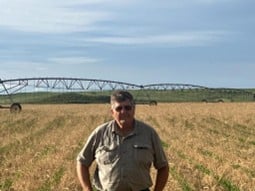
The following is a background on Mark McConnell from Preston, NE, for the CPRA Conservation Mentorship website with my permission to allow the use of this information to promote contacts and collaboration with anyone interested in sharing information and experience that they have encountered while trying to expand and grow their own conservation efforts and improve their stewardship of natural resources. Along with the last 30 or so years of trying to improve soil quality and improve water use efficiency on my own southeast Nebraska farm.
My journey along the path to reducing tillage and trying to improve water use efficiency has been a long-standing commitment that has evolved over the years. While there may be some of the reasoning behind many of the generations before me having used the excess of tillage in the loosening of the soil for what they thought were benefits that were supposed to improve crop production, it is obvious that the continuous tillage had some very negative long-term effects. Like everything else, moderation is a good thing. So with small steps in reducing the amount of tillage, in exchange for increased residue cover, we were still able to reach a level of crop production that made the system work. By still having the ability to create a fresh environment to establish that year’s crop, we still achieved success. In most cases, a few modifications to the equipment we used is all that was needed.
I have also done work on a terrace system on a technique a bit far from being considered a mainstream conservation practice. While this may seem a little unconventional, it may have some success when you fill in the fact that I have a very unique landscape and background in southeast Nebraska. A lot of terraces were built with a scraper pulled by a tractor and push scraper in the mid 60s to early 70s with limited experience and questionable design procedures. In an effort to improve the current condition of these structures, the practice of re-shaping them with a skid steer and re-seeding with a proper grass seed has been productive. Some of these terraces were built in the era when the popular practice was to use the South Four Ridge system, with both gradient and block terraces being used to achieve the needed result of reducing erosion. These systems are now being used as part of an overall effort to implement a no-till system with cover crops and include livestock integration. While some producers may have had their own experiences that led them to think these types of changes may not work, we are encouraged that the benefits have continued to mount. In order to truly implement a system that will be sustainable in the long term, it only makes sense that we should do everything we can to protect the basic natural resources that we have, and apply whatever building blocks that are available to make the needed improvements. Some of these changes may require a different mindset, with equipment changes and people believing that the time and effort that are put into conservation is necessary.
I have made my “Experimentals” a moving idea cover cropping systems that should help to address some issues with erosion, improve soil biology, and provide the ability to reduce nutrient use to levels which go to where the natural biology and organic matter are providing most of the work with just a supplemental boost. Everyone has been fairly limited in the belief that a system like this can be successful, but some of the success that I have seen does believe without a doubt that this is the direction everyone should be looking towards.
If anyone is interested in sharing thoughts on any of these topics, they can certainly contact me through the Center for Rural Affairs or by email at: markandlou@hughes.net
I’m not a PhD or have any exotic credentials other than experience and the desire to continue to make my farm legacy as sustainable as possible and hopefully help someone else do the same.
Let’s talk some more.